The Artful Way of Telling About the Holocaust Inna Rogatchi and Her Film on Simon Wiesenthal

By Leena Eronen (C)

Ha-Kehila, 1/2015, Finland
Witer / Film-maker Inna Rogatchi. Photo: Leena Eronen (C​).

The Artful Way of Telling on the Holocaust
Inna Rogatchi and her Film on Simon Wiesenthal
By Leena Eronen (C)
Ha-Kehila, 1/2015

In the Autumn 2014, we saw the Finnish premiere of a rare document, The Lessons of Survival. Conversations with Simon Wiesenthal.
At the event, I managed to meet with the film’s maker, Inna Rogatchi, just on the eve of her trip to Lithuania to film her next project, a mini-series telling the untold stories of the Warsaw and Vilna Ghettos.  

Born in Ukraine, Jewish writer and film-maker Inna is living in Finland for over 25 years.
Can you tell us more about your other films?

Almost all my films are of an hour’ length which is a good format for documentaries, to me. Among the persons whose personal portraits I’ve tried to create on a screen, are president Vaclav Havel, Elena Bonner, the wife of the Academician Andrei Sakharov, dissident Vladimir Bukovsky, politician general Alexander Lebed, and many others. I always was interested in not just making a personal profile, but to try to get into the psychology of my heroes; so it could be said that in all my films, psychology does play the main role.

I always has been and still am mostly interested on the point where history, culture and mentality meets, and am trying in my films to examine those cross-points via and by histories, biographies and characters of those personalities whom I was lucky to meet and know, and has made my films about.

The Lessons of Survival

Simon Wiesenthal ( 1908 – 2005)  went through seven labour and concentration camps. At the time of his liberation, he was an inmate of Mauthausen. He founded Jewish Documentation Centre and did help to bring to justice more than 1100 Nazi criminals. “Justice, not vengeance” was his well-known motto.

How did you meet Simon Wiesenthal?

I wrote a big article about him over 20 years ago, it was published in the Image magazine, and have got a very good reception. The article was enormous by its size, by the magazine has published it, still, as it was really unique story – reflecting the uniqueness of entire life of Simon Wiesenthal.

My husband Michael and I were very privileged to be a good friends with Simon for many years, we knew him well, visited him often, and thus, I have had that possibility to speak with him during the years.

Peter von Bagh ( 1943-2014), the patriarch of the Finnish movie world, did read my story in Image, and he has got very interested in it immediately. Peter wanted to do the film about Wiesenthal together with me, and asked me to talk to Simon about it.

It was not easy thing to organise, as Simon had endless requests for interviews, and his schedule had been always over-packed.
We were discussing the possibility of making our film for about a half of a year, and the important moment which convinced Simon to do it , was my view on the future film and its character as our usual friendly conversation. It should not be a regular interview, there should not be a distance, no formalities, no stiffness. Simon did like the idea, and agreed to make the film with a smile and readiness. He had a very disarming smile, and a smile does tell about a person a lot.

After Simon and I agreed about the way of doing our film, Peter ( von Bagh), our camera man Arto Kaivanto and I went to Austria to start the filming. Additionally to that, I’ve done a really big preparatory work, and serious historic research, too.
I was very privileged to work with materials from the incredible Wiesenthal’s Archive, and was yet more privileged to get comments on some of the documents by Simon himself. He also answered to all my questions regarding those incredibly interested and highly important documents, and always added very interesting stories related to it. Many of those documents were unpublished. So, there is a lot of new material in my film, thanks to that unique co-operation. My research work before, during and after the shooting took several years and I did it in both Austria and Poland, – tells Inna.
We were filming Simon for four days, and during couple of more days, we were filming Mauthausen and Linz. The conversations that we’ve filmed with Simon, were really very long ones, as the talks between friends usually are. I still be amazed that does matter how many times we would be talking with Simon and discussing various things, he would never repeat himself in any conversation with me, ever. He had that very rare ability to remember what he was discussing with certain person, and did not repeat himself, for once, with me, during all those years and numerous conversations. It is a very rare ability of a truly brilliant brain and phenomenal memory that he had.
When I mentioned to him that we will be filming Mauthausen on our own, without requesting him to come with us, Simon did thank me very much, indeed.  I never do that kind of ‘vivisection’-journalism, and never could imagine to ask the people who already did suffer so much, to return to the camp, to talk on the camera on that. I categorically refuse to do anything like that.
Our camera man, Arto Kaivanto, professional through and through, who had seen many terrible things in the world, did ask me in the evening, after we returned from our filming day in Mauthausen, on had I noticed that for some while his camera worked without him – as he had lost consciousness while filming the certain places of that place of sheer horror.  

The film had been planned by Peter ( von Bagh) to become a part of his Golden Library, a series of biographies of the twenty most remarkable people of the XX century.

Tohtori Inna Rogatchille luovutettiin vuoden 2014 Patmos
Solidaarisuuspalkinto
tunnustuksena hänen työstään kulttuurin,
hyväntekeväisyyden ja julkisen elämän, moraalisten arvojen sekä
ihmisarvoisen elämän puolesta. Hänen elokuvansa Simon Wiesenthalista
hyväksyttiin äskettäin United States Holocaust Memorial
Museumin kokoelmiin.
hakehila 43

But then Peter was so very busy with many of his projects, and the Golden Library left as a good idea only. A few years after the filming Wiesenthal, I have discussed with Peter von Bagh my intention to do the film by myself. His response to that was positive, and my production company has bought the entire material and rights from the Peter’s company.  That was the start of my producing and making the film”, – says Inna.

The European Premiere at the European Parliament

The Lessons of Survival film has been presented internationally widely – its European Premiere had been at the European Parliament at the commemoration of the Holocaust & Remembrance Day 2014, and it had been presented at the special session of the European Club of the Seimas ( Parliament ) of Lithuania.

Additionally to that, among many other international institutions, Yad Vashem, Columbia and Hebrew Universities has acquired the film.

In the spring 2015, the Australian premiere of the film will be launched in both Melbourne and Sydney at the largest in Australia and New Zealand Jewish International Film Festival. In June 2015, the film will conclude the Faces of Humanity Festival in Chicago, in the joint project of the Illinois Holocaust Museum and the Chicago Film Festival.

The official trailer of the film can be seen at the Youtube

Among the new historic materials in the Inna Rogatchi’s film, there are those related to the searches of both Adolf Eichmann and Josef Mengele; new information and details concerning the Wiesenthals’ dramatic experiences with opening, closing and re-opening of his office , his tireless search for Nazis all around the globe, as well as new knowledge on the search and arrest of the officer who has arrested Anne Frank.

I have told to Inna that I saw her film at its Finnish premiere in Helsinki in the Autumn 2014. The music plays a very special role in this film, and as if opens it up even deeper.  When I was watching the film, very often I had a strong feeling that I am watching art-film.

-Was it the purpose, to make an art-film, Inna?
– It is very well said, as it was precisely the purpose. When Ruth Diskin, Israeli distributor of the film, watched it, it was her reaction, as all. She is of an opinion that the film is unique and touching. And I have an explanation for that – this film is not a regular documentary, it has been neither conceived, or executed that way. A very special role in the film is played by original art by my husband Michael Rogatchi, mine original art  photographycollages, and the music by the one of the best modern Israeli composer Israel Sharon.

All this art applied and integrated in the film, has created its own world which affects people’s perception in the special way.   The paintings of my husband are deeply metaphorical, he is a world renowned master of the metaphorical expressionism. The one of the art works which are playing important role in the film, The Way, had been with Simon and Cyla Wiesenthal for many years, and they did write to us that they did like it very much.

When Peter von Bagh saw the ready film in spring 2014, he wrote to me: “it is beautifully done”. He was really happy that such great and very special material has got into a film. And I, too, was very glad that Peter who did fight cancer for long, lived to see the film. It is important for me.  

On Modern Anti-Semitism

Next we turned to a big issue.
How anti-Semitism has been originated, in your opinion? From which source did it sprang?

Do you mean the hatred against Jews before and during the Second World War, or modern anti-Semitism? Although, there is a direct and strong inter-connection between those two stages of the same phenomenon, in my opinion. I do think that after the end of the Second World War, there has been absolutely not enough done and said about the horrific, devastating tragedy that Jewry of Poland, Central Europe, France, as a matter of fact, the Jewry of entire Europe went through during the Nazi regime and the Holocaust. It was and still is absolutely unparalleled.

And as unbelievable as it is, there is very little researched and said on what has happened to Jewish survivors of the Holocaust and their families just and soon after the end of the Second World War. The entire subject has been brought as the matter of to public discussion only several years ago, and since then, only few books has been written about it.  

After all that unspeakable horror, the houses and belonging of the victims of the Holocaust were taken from them, people were literally robbed, neglected, abused, – and it was not matter of interest of anyone in any country for decades. It does tell you something about hatred towards Jewish people which was overwhelming and the scale of it is still shocking, to me.  I am absolutely sure that the subject has to be researched much more better, and its results should be publicised as widely, as possible.

Anti-Semitism has originated from a very long tradition, to the extent that when we, Jewish people, are talking about it in between ourselves, it comes with the assumption that ‘it has been always there, that it is a part of life’. But come on, this very way  of thinking is quite abnormal, to say the very least.

Coming to the modern anti-Semitism, it has become so open, ugly and arrogant that my husband and I never believed that we would never live the day to see it so bad, and that it will become a reality, as it has become nowadays.

Anti-Semitism has become fashionable, and that’s the main problem of nowadays, as far as I am concerned. It is just terrible to see what’s happening in Sweden, France, United Kingdom; even in Miami, the violent anti-Semitic attacks started to happen now, it was impossible thing to imagine yet a half of year ago.

The most dangerous phenomenon of the present day, the extreme radical Islamists, are swiping all over Europe and the USA, and it is looming huge problem. Under the circumstances, it is vital, in my view, that the civilised, human society will handle that threat as best and fastest, as possible.

Helsinki, December 2014.

Inna Rogatchi’s The Lessons of Survival Film Acquired by Arizona State University

Inna Rogatchi’s film about Simon WiesenthalThe Lessons of Survival, has been acquired by Arizona State University, ASU (USA).

ASU is known in the United States as one of the leading, top-ranking national educational institutions, and is highly reputed internationally for their programmes of Jewish and Holocaust Studies. They are renowned for their international co-operation and many initiatives in the field.

Inna Rogatchi’s Film on Simon Wiesentha acquired by the United States Holocaust Memorial Museum

Inna Rogatchi’s Film The Lessons of Survival. Conversations with Simon Wiesenthal has been acquired by the United States Holocaust Memorial Museum in Washington, D.C.

The United States Holocaust Memorial Museum in Washington, D.C., USHMM, is internationally renowned as the US national memorial and leading institution on the theme of the Holocaust.  It is a member of Big Four leading institutions on the Holocaust in the world, together with Yad Vashem, Memorial de la Shoah in Paris, and Berlin Jewish Museum. The USHMM Holocaust Film collection is highly selective.

Previously, Inna Rogatchi’s Film The Lessons of Survival has been acquired by Yad Vashem, the Columbia University and Hebrew University, and many other institutions.

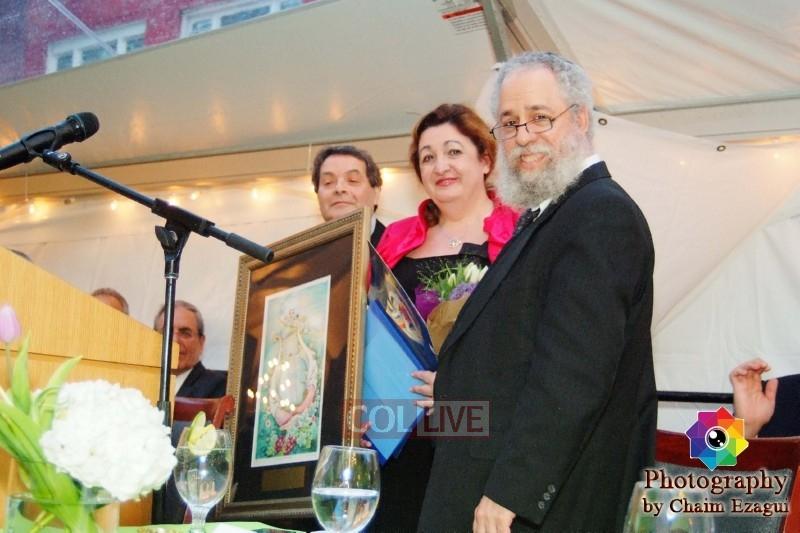
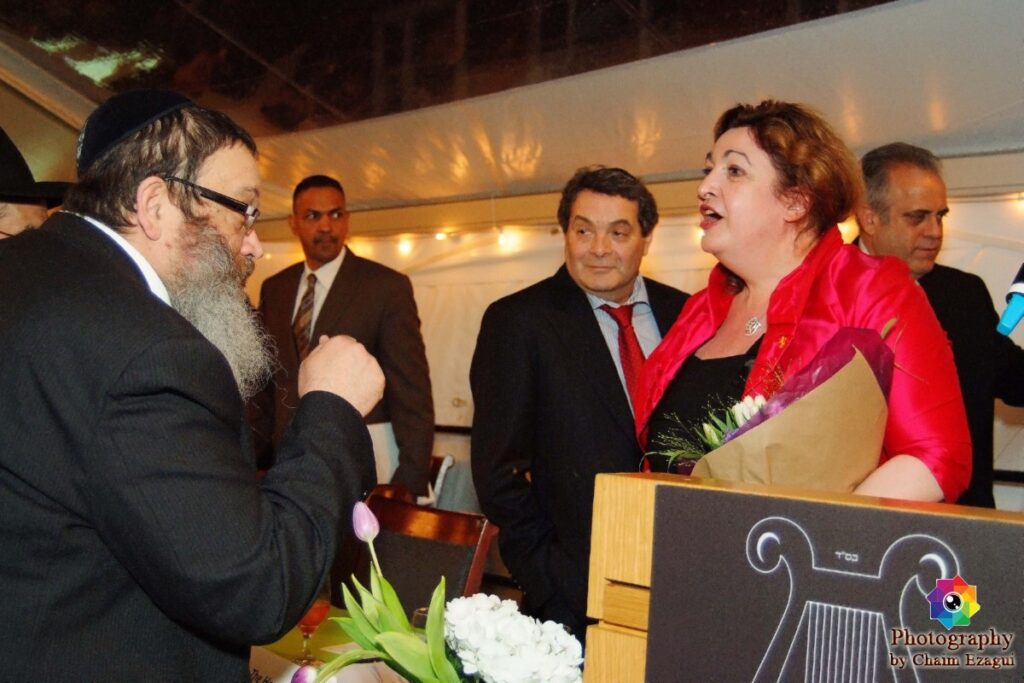
Inna Rogatchi Awarded with the Patmos Solidarity Prize

In December 2014, Inna Rogatchi has been awarded with The Patmos Solidarity Prize  – ‘honoring her life  long mission for the sake of the persecuted Jewish People and the State of Israel”.

More about this event and the story at the –Israel National News

“The Lessons of Survival” Profile on Inna and Michael Rogatchi

Artutz Sheva, Israel National News, speaks to Dr. Inna Rogatchi, writet, film-maker and photographer, whose latest project is a film starring Simon Wiesenthal.

Writer & Film-maker Inna & Artist Michael Rogatchi. Courtesy : The Rogatchi Archive(C)

“The Lessons of Survival” – Profile on Inna and Michael Rogatchi

“I survived and that was a miracle”, says the late Simon Weisenthal, summing up his Holocaust experiences in a recently released documentary “The Lessons of Survival”, filmed by Dr. Inna Rogatchi. The riveting film is based on her never-before publicized conversations with the larger-than-life Nazi hunter as well as her own research into fascinating stories and facts about the Holocaust.

Yad-Vashem has officially requested the film for their permanent film collection and library and Dr. Rogatchi was the special guest author at the European premiere of the film at the European Parliament’s commemorative events for International Holocaust and Remembrance Day 2014. The film was also screened and discussed at the Seimas (Parliament) of Lithuania at a special event in March 2014.

Inna Rogatchi, too, is larger-than-life. The internationally acclaimed writer, journalist, fine art photographer, movie maker and scholar enjoys studying inter-connections between people, history, and culture, and is also the creator of the Lux Sei Photo Art © concept in fine art photography.

She and her artist husband Michael, renowned European master of “metaphorical expressionism” are in Israel during the Passover season and Arutz Sheva took the opportunity to enjoy a cup of coffee with the indefatigable Inna, whose activities and accomplishments are too varied for one article to be able to do them all justice.

Inna described how she decided to “take on Soviet Russia” despite the personal risk involved when she published her book “The Shattered Generation, or The Ten Commandments in the USSR” (1992) a multifaceted, comprehensive analysis of Russian society and mentality. The book was short-listed for the Russian Booker Prize, acclaimed as “the encyclopaedia of the entire Russian life and character” by writer Irina Ratushinskaja, termed a “Nobel-prize worthy portrait of Russia and the Russian character” by analyst and intelligence expert Victor Suvorov.

“Around that time, we realized we had better leave Russia”, she said, “because my book ‘Yellow Star in the Red Sky’ (1995) is an anti-Soviet study of modern-day Russian anti-Semitism and extreme nationalism – and it was beginning to be acted out, against us.”

The book is exhibited in both Yad-Vashem Museum and the World Museum of Anti-Semitism in Israel. A special exhibition on the topic of modern anti-Semitism based on this book has been shown many times in Finland and other Scandinavian countries at numerous events and forums dealing with the most acute problems of international development.

Why Finland? The Rogatchi’s gave up their Russian citizenship and moved to Finland, where they had lived during their 12-year old daughter’s tragic bout with cancer. Inna recounts the sad story: “There was no fallback position in the USSR when the Chernobyl disaster struck. They had no contingency plans, no instructions – the authorities said whatever they chose to say, but no one knew it at the time. Our parents lived near Chernobyl and the official word was that it was now safe again. We sent our daughter to visit them and she soon developed a rare form of incurable cancer that is a result of exposure to radiation. Wonderful people who knew us through our writings and art helped us get to Finland where they were able to extend her life for a year. After she died, that seemed the best place for us to stay. And that is where I do my writing today.”

A proud Jew and ardent Zionist, Inna says that she fears for the future of the West and writes and lectures on the dangers of militant Islam. “I wrote a series called ‘The Origin, Objectives, Realities and Implication of the Militant Islam in Europe’ – consisting of research, studies, presentations and public lectures I gave at the Institute of the World Politics, Washington DC (US), and other international institutions on one of the most important phenomena of international development.”

“It is a story of pretending nothing is happening although the facts stare you in the face. My article ‘Tolouse and Gaza’ – on the reaction of high European Union officials to militant Islamist crimes in Europe, also dealt with that tendency. I later wrote ‘Future of Europe’ – on the dangerous rise of ultra-nationalistic and extremist movements in Europe”.

The ongoing Ukraine crisis led Inna to send Arutz Sheva an illuminating article, “Tea with Neo-Nazis” – on the violent nationalism in Ukraine and its anti-Semitic overtones, which was re-printed all over the world, in Poland, Canada, USA, UK, and other countries.

She had previously written “Pilgrimage to Home”, an essay about the modern-day view of Ukrainian Jewish history and “Beginning of Decency”, a detailed analysis of the crucial changes in Russian society – “it is actually a protest against Putin’s regime”, she explains. “It hurts to see how the revival of Jewish life I depicted in ‘The Legacy of Light: Drama and Revival of Jewish Life in Ukraine’ collection is endangered once more.”

The collection is the part of a massive exhibition project in London and New York that will be shown beginning in the year 2014.

“It’s necessary to see Jewish life in an historic perspective”, she says, introducing her photographic exhibit, “The Route”, a collection illustrating the directions taken by Jewish people from the Middle Ages through modern times. It has become part of the Israeli Holocaust Museum Yad Vashem’s Virtual Centre, and provides material for their educational programs.

“The Family Edition of ‘The Route'”, she continues, “is on permanent display at the Jewish Memory and Holocaust in Ukraine Museum, the largest of its kind in Eastern and Central Europe.”

Dr. Rogatchi was special guest artist invited by the European Parliament to launch the collection in commemoration of Jerusalem Day 2012 in the presence of former MK Benny Elon and the Israeli state delegation led by then Minister Yossi Peled. Hundreds attended the event, and all sang Jerusalem of Gold – including the Polish president.

Inna comments: “I am an ardent Zionist and love my people and their country with all my heart – and hope that we will soon be able to make Israel our permanent home, although unfortunate circumstances prevented us from moving earlier.”

The most moving of the many instances of Inna Rogatchi’s unceasing efforts to make the world a better place, concern the way she and her husband memorialized their only daughter. Not long after Julia’s death, the Rogatchi’s founded Arts Against Cancer, an international charity which organized performances by famous musicians, using the proceeds to improve care for young cancer patients.

The Chairman of the Board was maestro Mstislav Rostropovich, and among the members of the International Advisory Board were Queen of Denmark Margreth, Sir Paul and Linda McCartney, Maurice Bejart, Vladimir Spivakov, and many other outstanding figures.

The foundation covered medications, helped sick children get the best available treatment, funded high level oncologists, among other projects. “It was a way of trying to give others the loving care our daughter received and maybe even have a happier ending to their bout with cancer.”

The foundation’s success for over a decade led to the couple establishing The Rogatchi Foundation, which actively supports international educational, cultural, and charitable activities, such as funds for a special program and stipend for the Jewish orphans in Ukraine – the Annual Yenike Stipend, and Home Care for Jewish orphans who are ill.

Among the members of the International Advisory Board of The Rogatchi Foundation are maestro Evgeny Kissin, Member of the European Parliament Sari Essayah, deputy Speaker of the Lithuanian Parliament Petras Austrevicius, leading French philanthropist Marie-Helene Berard, leading British-American business woman and philanthropist Dr Herta von Stiege. Member of the European Parliament Hannu Takkula is also a member of The Rogatchi Foundation board.

Inna adds “We have organized a five-year special programme for teachers in Ukraine, introducing a special Award for Teacher Excellency, to stimulate teachers to conduct their job with more energy and appreciation, and to remind the public of the noble role of teachers in any civilised society.”

The noble role filled by the Rogatchi family in so many spheres is an example that is difficult to emulate. It is no surprise that the Rogatchis were awarded The Couple of the Year Award for Contribution to the Arts and Culture by the New York Jewish Children’s Museum, and are recipients of many other international awards.

Melody of Life: Life & Art of Michael & Inna Rogatchi

JLTV, Los Angeles, USA

The programme can be watched here.

Inna & Michael Rogatchi at the Michael’s The Rogatchi’s Blues exhibition opening, Florence, Italy. May 2011. Courtesy:The Rogatchi Archive (C).

Melody of Light: Life & Art of Inna and Michael Rogatchi is the TV profile of the artistic couple that has been produced by and for the JLTV,  a major international TV Channel based in Los-Angeles with bureaus world-wide.

The programme has been very successfully broadcast many times in the USA, and later on has been shown by the Dannish TV. In both, the USA and Denmark, the programme has been chosen as the Channukah Special for 2013 and 2014.

The programme covers some of the both artists’ art and also follows their over 25 years long philanthropy activities.

JLTV is a major international TV Channel that covers over 100 million households all over the USA, Canada, Mexico, Europe, Israel, and  the Middle East. 

The Melody of Light programme has been recognised internationally: it has made it into the Mashmedia (online Multimedia Encyclopedia) top programmes in the Art of Living category; and the story about the programme has been published in many international media. 

The documentary has been acquired by  Yad Vashem for their permanent Film Collection and Film Library, the biggest in the world on the subject of the Holocaust.

The Route of Inna Rogatchi

by Irina Lazareva

Shabat Shalom magazine  Dnepropetrovsk, Ukraine

If a person is talented, he or she is talented in everything. Inna Rogatchi’s name is known not just to an intellectual elite. Renowned author from Finland and the president of The Rogatchi Foundation has donated the collection of her fine art photography to our Holocaust Museum recently. The previous edition of the collection had been very successfully exhibited at the European Parliament last year. Now the wide public of Dnepropetrovsk and the visitors would be able to see this very valuable collection of works embraced by The Route title.

As stated in the exhibition catalogue, The Route series is based on the author’s artistic and historic research. In this research, Inna has reflected her personal visioning and understanding of the historical way of the Jewish people from early Medieval age to the present day. The works cover 15 countries and have been taken during the previous decade.

The exhibition had been opened by the Chief Rabbi Schmuel Kaminetzki. With his customary fine humor, he had noticed that there is everything fine in our city with things religious and business-like, but the same cannot be said of cultural matters. That’s why the Rabbi has emphasised Inna and Michael Rogatchis’ contribution into developing the cultural aspect in our community life, and in the city in general, and thanked them both very much for their ongoing effort to bring more culture and to put more weight also in our education here. It would be appropriate to mention in this regard The Rogatchi Foundation’s meaningful stipends to our best pupils that they have been awarded with this year, as well.

One of the most well-known and highly respected leaders of the world movemevent of Chabbad Lubavitcher, Rabbi Moishe Kotljarsky addressed the audience with a highly charged, emotional speech. He did emphasise that the Jewish Memory and Holocaust Museum is having rather special place in his heart as it was him who was sanctifying Mezuza here at the Menorah Centre opening ceremony in October 2012. The leader of Chabbad Lubavicher movement also recalled a particular episode of himself visiting the Madame Tussauds museum in London and going ‘still’ among the various exhibits; he has returned to reality only by multiplied blicks of Japanese tourists’ cameras. Years later, today, he is feeling himself as an amazed youth again when he is looking at Inna Rogatchi’s works presented at the exhibition.

And indeed, there are plenty of reasons to stay still in front of Inna’s works. We are stunned to see the original bell from the Columbus’s Santa-Maria ship. On board there were very many members of the Spanish Jewish community; the people whom Columbus was saving literally, and who were sailing with him to the shores of freedom. We also as if taken into the small streets and mountain landscapes of the small but meaningful Italian town of Pitigliano known also as ‘little Italian Jerusalem’. We are enlightened by the Garden of Joy created by the fine and thoughtful Beatrice Efrussi de Rothschild at her villa in France. We are amazed by the unusual view of Amsterdam known among its Jewish population also as Mokum, ‘town’ in Yiddish. We are engaged by the author’s personal travel through Jewish places ofPolandCzech RepublicAustriaGermany and Kazakhstan. And among them all, we are happy to recognise the very spirit of the Jewish places of our city in outstanding Red Balcony work depicting the old quarters of Dnepropetrovsk. There is plenty to see at this great exhibition, by many accounts.

But there is more. As a literary person myself, I was quite taken by the author’s highlights to her works which Inna did for every exhibit of her collection. I was reading them as thrilling high-class literature, and was only breathing in disbelief every time coming towards the end of each of those commentaries : “That’s it? The ending?.. What a pity!..”

Inna has dedicated the exhibition to her father Isaac Bujanover, who was an engineer and keen photographer. In her speech, Inna has noted that her connection with Dnepropetrovsk is inseparable. Whereve she goes during her quite intensive travelling all around the world, in her thoughts she often is here, in the place where she spent her childhood and youth.

For me personally, the meeting with Inna Rogatchi had been quite significant, too. Her mother, Anna Bujanover, the Teacher with a big T, had been invited in the 1980s of the last century – how time flies, indeed! – to the Dnepropetrovsk university with a series of lectures on her innovative and creative methods of teaching; and I was among the lucky students there. We were elite students at the philology faculty there, and were quite spoiled by top professors who taught us all those years. We were arrogant and superior, – we thought. But I still remember quite vividly like all of us were sitting at Anna Bujanover’s lectures as ever-green first-grade students, jaw-dropped, absorbing those brilliant lectures from A to Z. What lectures Anna Bujanover presented to us, what a gift it was!.. The quarter of a century has passed from the time of those unforgettable lectures of Inna’s mother, and there are so many materials had appeared since then for the teacher who refuses to be indifferent – but all that time, I am using Anna Bujanover’s methods in my work, as many and many of my colleagues still do.

Luckily, there were many children at the opening of Inna Rogatchi’s exhibition. And still, it would be right, appropriate and much needed to open our new school year by bringing children to this exhibition massively. I do believe that all our pupils have to see and to estimate those quite extraordinary works. I do believe that children are the best ‘lithmus-paper’ test for any kind of art – would it be art photography, paintings, movie or theater. Children are not necessarily able to express their impression by words, but their faces tell a lot. And at this exhibition, the works’ glass has reflected the thinking, surprised, and – rapturous faces of my pupils. Bingo, Inna!

Irina Lazareva

Shabat Shalom magazine, issue 7, June 2013

Special Award For the Outstanding Contribution into the Arts and Culture to Inna and Michael Rogatchi

New York Children’s Jewish Museum – May 2013In May 2013, Inna and Michael Rogatchi has been awarded with the Special Award for the Outstanding Contribution into the Arts and Culture by the New York Children’s Jewish Museum, the largest Children museum in the USA.  The Rogatchis has been awarded in a company of Maestro  Evgeny Kissin and the legendary New York  High Commissioner Raymond Kelly.

The Photographic Power of Memory

By Leona and Jerrold Schecter © 2013 –

Introduction for

Inna Rogatchi’s The Legacy Of Light: The Schneerson Family Collection

RESTORING IMAGES OF JEWISH LIFE IN UKRAINE

For Inna Rogatchi the camera is an extension of her eye and heart. With them her memory captures quiet but deep passion. Inna’s The Schneerson Family Collection is a keystone to understanding Jewish life in Ukraine. Inna Rogachi’s honest and beautiful pictures restore a history that demands to be seen, told and remembered.

Memory can be stimulated by sight, sound or smell. We speak of a memory bell ringing and it brings a past moment back to our mind’s eye. The sweet scent of jasmine might remind us of a far off place and first love. For Inna Rogatchi the camera is an extension of her eye and heart. With them her memory captures a quiet but deep passion that evokes the Holocaust by remembering not only the violence and barbarism, but the peace and joy of normal life that it destroyed. Inna and her husband Michael have devoted their careers to restoring the memories of Jewish life before Hitler and Stalin and preserving them for future generations. They were among the active and most notable supporters of the world’s largest multifunctional Jewish Community Center Menorah and Museum, which opened in Dnepropetrovsk in October, 2012.

Inna’s pictures return us to a time in Ukraine, then a part of the Soviet Union, when Dnepropetrovsk was a thriving industrial center invaded by Nazi troops. On August 25, 1941, 11,000 people, including close family members of Inna and Michael, were slaughtered. Inna’s pictures honor their lives and are an integral part of the legacy that remains.

Her photographs, with skillful and sensitive color enhancement, reveal the simple but pure essences of nature and life in the remains of the neighborhood in the old town of Ekaterinoslav, later re-named as Dnepropetrovsk, where the Schneerson family lived and has been rooted for many decades.

Inna’s The Schneerson Family Collection is a keystone to understanding Jewish life in Ukraine. It was along the banks of the Dnieper River in Ekaterinoslav, today renamed Dnepropetrovsk, where Rabbi Levi Yitzchak Schneerson lived for the more than thirty years, serving as the chief rabbi. He was renowned for his Talmudic scholarship, interpretations of Kabbalah and Jewish law. He played an influential role in religious and community life in the flourishing city, while educating his son, Menachem Mendel. Jews were a vital part of Dnepropetrovsk’s life, constituting more than one-third of its population and owning an estimated 25 percent of its factories.

Menachem Mendel Schneerson studied Torah under his father and other learned wise men. By the time he was 17 he was considered an Illui or genius, marked for leadership in the Hassidic religious order. The routine of daily morning and evening prayers, study and commentary on the Talmud and Kabbalah dominated daily life. The Torah and its laws provided the community’s moral center.

Menachem Mendel married the daughter of the Sixth Rebbe Yosef Schneerson who in 1940 fled through Europe to America and settled in Crown Heights, Brooklyn, New York. So did Menachem Mendel who was studying in Berlin until 1939 and fled with his wife to Paris and to Brooklyn Heights in 1940 on one of the last boats to escape the German U-boat blockade.

Menachem Mendel became the Seventh Rebbe, the Lubavitcher Rebbe, in 1951, a year after his father-in-law died. The Seventh Rebbe, who spent his youth in Dnepropetrovsk, retained his connection to Ukraine until he died in 1994. Inna Rogachi researched the places of his youth, and the other places connected with the Schneerson family in Dnepropetrovsk, and they are the core of her photographs.

Today the Hassidic Chabbad-Lubavich has a network of 3,600 institutions, including schools, synagogues and kindergartens in over 70 countries and 1,000 cities throughout the world.

Inna’s photographs show the soil in which its roots were planted and the first fruits harvested. Studying her pictures, with their squares and rectangles of deep colors, one can conjure the inspiration for Mark Rothko, the Latvian Jewish painter, a leader of the Washington Color School. Where such art comes from is in the shapes of the buildings and memories of youth.

Memory can play many cruel tricks but Inna Rogachi’s honest and beautiful pictures restore a history that demands to be seen, told and remembered.

Leona and Jerrold Schecter , Washington DC, USA.

Leona and Jerrold Schecter are prolific historians and writers,  co-authors of several internationally acclaimed books on modern history, including Sacred Secrets: How Soviet Intelligence Operations Changed America History.

Inna and Michael Rogatchi as the Guests of the YIVO Heritage Gala

Inna and Michael Rogatchi has attended the YIVO heritage Gala in New York in May 2013. The Member of The Rogatchi Foundation International Advisory Board Maestro Evgeny Kissin had been honoured at the event. The Gala has been marked by the extra-ordinary key-note speech by the YIVO President Nobel laureate Elie Wiesel.

Appreciating the Spirit of Italian Cinema

“Inna Rogatchi’s Amarcord Forever exhibition is one of the most interesting amongst many events to the 69th Venice Film Festival that will be filling the agendas of movie aficionados who will swarm the lagoon.

The fact that the two events are scheduled simultaneously underlines the Festival’s aptitude to emphasize the true spirit of Italian cinema and to jealously protect its tradition. Amarcord Forever is an unmissable opportunity to live the Festival, appreciating its spirit, which has always been its distinctive trait, to the fullest.”

Italian Talks Art Blog, Milan, Italy, August 2012.

Seeing Through the Time: A Jewel Suspended in Midst

By Maija-Liisa Marton

The ROUTE Exhibition Catalogue. Brussels, 2012. 

The European Union

Inna Rogatchi ©. Presence. Beatrice Ephrussi the Rotschild’s bench. Cap Ferrat. France. 2010.

It is a rare gift to be given the chance to partake in something as personal and subtle as Inna Rogatchi’s photographs in her exhibition From Europe to Jerusalem: The Route. Through the photographs the viewer is generously allowed to have a glimpse of a private journal depicting and describing a long quest for the past and the present.

It is with awe and trepidation we join her to travel over the punishing landmarks of her people’s history. We walk through the narrow passageway in Toledo. We blink our eyes in daylight of the Venice Jewish Ghetto. We pause to listen to the distant tune of a waltz in Vienna. The calmness and lucidity, with which Inna Rogatchi takes us for a walk on the cobblestone street in the Vilnius Jewish Quarter leaves the viewer with a strange sense of understanding and foreboding. It is an invitation to reflect upon the irrationality of the world.

Then, all of the sudden, there is a gentle breeze in the air and, like a jewel, suspended in mist, there is the Florence Great Synagogue. Or, like in the photograph of Chagall’s View, the bliss that one feels of seeing the skies open wide and far.

For me there are two photographs, which captivate the imagination. Time and again I return to the young girl perusing her book at candlelight in Kazimierz Hours, the title work of the current exhibition. There is a tiny rocking horse, and through the window pane the old, uncompromising stone wall is pressing in. The other is the bench in the Beatrice Ephrussi Rothschild garden. The shadows have their tale to tell, but there is a starry, playful spot of light on the seat and another, smaller one on the back whispering of something that is constant, something that remains.

It is, however, Jerusalem, from where Inna Rogatchi’s journey begins on an age-old alley passing the gateway, in A Passage through Eternity. And it is Jerusalem, where her journey ends in front of the white, sun-lit walls and under the powerful arch of the historical and recently restored synagogue, Hurva.

Inna Rogatchi’s fine perception and sense of human frailty make her visual world interesting and deeply moving. It makes me reflect on the words of Paul Johnson in his modern classic A History of the Jews: ‘No people has ever insisted more firmly than the Jews that history has a purpose and humanity a destiny.’ There could not be a better confirmation of the statement than Inna Rogatchi’s personal journey shared by us in her photographs.

May 2012

MAIJA-LIISA MARTON, actress, director, Finland, Dr. of Arts, h.c., Shenandoah University, Virginia, USA